
10 Practical Ways To Use AI In Your Marketing Strategy
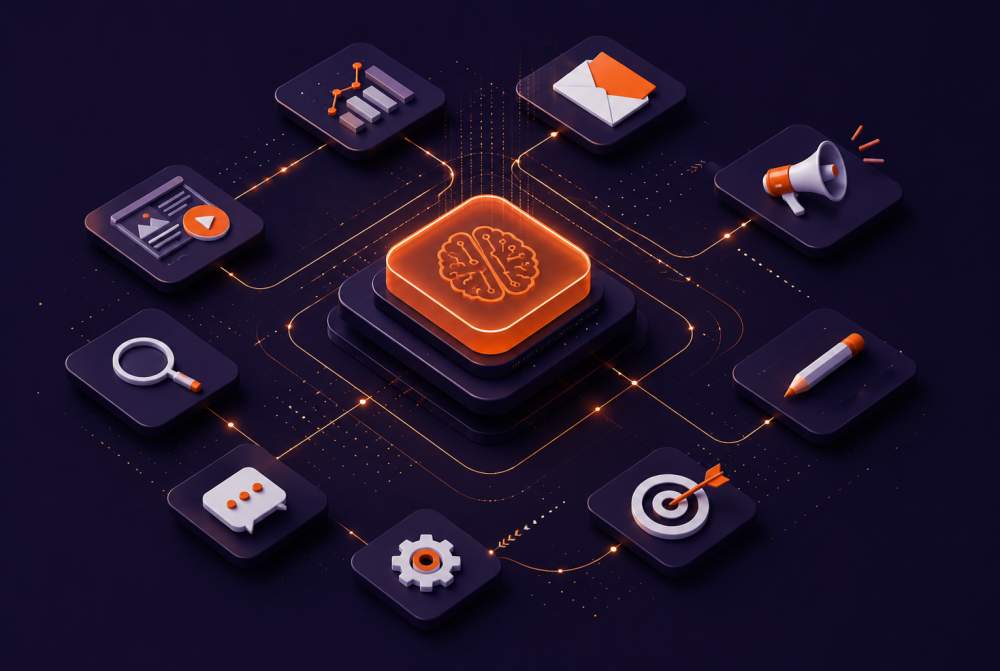
AI in marketing is no longer a future concept. It is already shaping how teams plan, execute, and scale marketing strategies.
But most companies still approach it as a collection of tools. They experiment with a new AI tool here, automate a task there, and expect meaningful results.
That approach rarely holds up.
Marketing with AI works when it is treated as part of a broader system—connected to your product, your data, and your infrastructure. Without that foundation, even the most advanced AI capabilities produce inconsistent outcomes.
This guide focuses on what actually works.
You’ll learn how to use AI in your marketing in a way that is practical, scalable, and aligned with real business needs.
Why AI In Marketing Often Falls Short
AI in marketing is often presented as simple: pick a tool, automate tasks, and scale results.
In reality, most marketing teams run into friction quickly.
Where AI tools break in real-world workflows
Many AI tools operate in isolation.
They generate content, analyze data, or automate campaigns—but they are not connected to your broader systems. This leads to fragmented workflows and duplicated effort.
A marketer may generate content using generative AI, but without integration into CMS workflows, version control, or QA processes, consistency suffers.
The gap between automation and scalable systems
Automation is not the same as scalability.
AI automates tasks, but scalable systems require:
- Reliable data pipelines
- Clear business logic
- Consistent outputs
- Monitoring and iteration
Without these, AI usage creates more noise than value.
Why marketers and engineers need to align early
AI sits at the intersection of marketing, product, and engineering.
Marketing teams define use cases. Engineering teams enable data access, infrastructure, and integration.
When these functions are disconnected, AI initiatives stall.
What Changes When You Treat AI As Part Of Your Product
The shift from “using AI tools” to “building AI-powered systems” changes everything.
AI becomes a layer in your architecture—not just a feature.
AI as a layer in your product and data stack
AI models rely on structured, accessible data.
That means your marketing systems must connect to:
- CRM platforms
- Analytics tools
- Product usage data
- Customer feedback systems
This is where AI and machine learning become meaningful—when they operate on reliable inputs.
Connecting marketing workflows to backend systems
Marketing with AI is most effective when workflows are integrated.
For example:
- Content generation tied to product updates
- Campaign targeting based on real-time user behavior
- Predictive analytics connected to sales pipelines
This requires API-driven systems and thoughtful design.
Building for reliability, not just output
AI-generated output is easy.
Reliable, repeatable output is harder.
AI systems need:
- Validation layers
- Monitoring
- Feedback loops
Without these, results degrade over time.
The Benefits Of Using AI In Marketing (When Done Right)
The benefits of using AI are real—but only when AI is implemented thoughtfully.
Faster execution without sacrificing quality
AI helps marketers move faster.
Content creation, campaign setup, and analysis can be accelerated significantly. But speed only matters when quality remains consistent.
Better insight from structured data
AI enables deeper insight into customer behavior.
With predictive analytics and machine learning, teams can identify patterns that are difficult to detect manually.
Scalable personalization across channels
AI-powered marketing allows for personalization at scale.
Email marketing, content marketing, and paid campaigns can adapt dynamically to user behavior.
Reduced operational overhead for teams
AI automates repetitive marketing activities.
This frees up marketing teams to focus on strategy, experimentation, and creative direction.
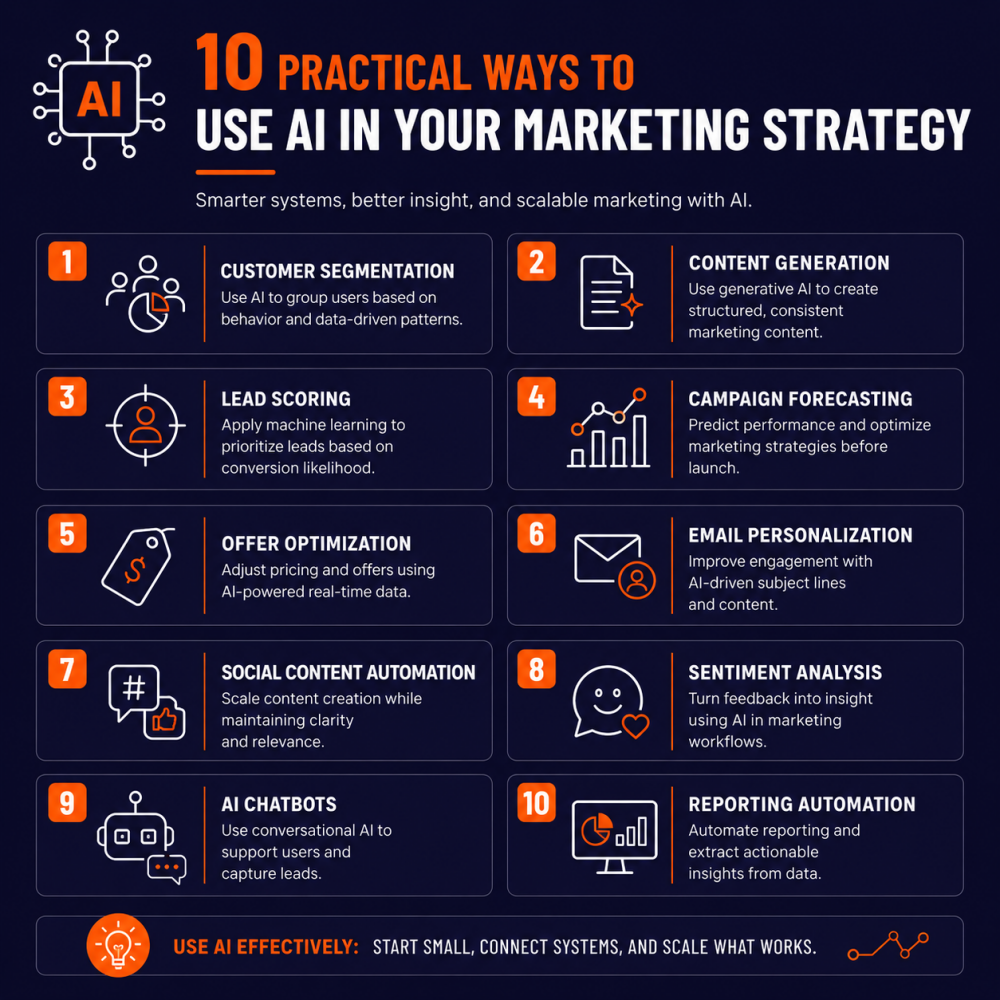
10 Practical AI Marketing Use Cases That Actually Scale
These are not theoretical use cases. Each one reflects real applications in marketing that can scale when implemented correctly.
1/ AI-powered customer segmentation
AI allows teams to move beyond basic segmentation.
Instead of static lists, machine learning models analyze behavior, engagement, and purchase patterns.
What matters:
- Clean, unified data sources
- Consistent tracking across channels
Common issue:
Poor data quality leads to unreliable segments.
2/ Content generation with structured workflows
Generative AI is widely used in content marketing.
But effective AI usage goes beyond one-off prompts.
Best approach:
- Define templates and guidelines
- Implement review workflows
- Track performance across versions
AI tools can help scale content, but structure ensures consistency.
3/ Predictive lead scoring
AI models can evaluate leads based on likelihood to convert.
This improves prioritization for sales teams.
Requirements:
- CRM integration
- Historical conversion data
- Clear scoring logic
Predictive analytics is only as strong as the data behind it.
4/ Campaign performance forecasting
AI can analyze past campaigns to forecast future performance.
This helps teams allocate budgets more effectively.
Key benefit:
Better decision-making before campaigns launch.
5/ Dynamic pricing and offer optimization
AI enables real-time adjustments to pricing and offers.
This is particularly useful in SaaS and e-commerce.
Challenge:
Requires fast, reliable systems and clear constraints.
6/ AI-driven email personalization
Email marketing remains one of the most effective channels.
AI enhances it through:
- Personalized subject lines
- Content recommendations
- Send-time optimization
AI ensures that every message is more relevant to the recipient.
7/ Social media content automation
AI automates content generation and scheduling.
But not all content should be automated.
Where it works:
- Draft generation
- Repurposing content
Where it fails:
- Brand voice consistency
- Context-sensitive messaging
8/ Customer feedback and sentiment analysis
AI can analyze large volumes of customer feedback.
This includes:
- Reviews
- Support tickets
- Survey responses
Outcome:
Actionable insights that inform product and marketing strategies.
9/ Chatbots and conversational AI
AI chatbots handle customer interactions at scale.
They can:
- Answer common questions
- Guide users through onboarding
- Capture leads
Conversational AI works best when integrated with backend systems.
10/ Marketing analytics and reporting automation
AI automates data aggregation and reporting.
Instead of manual dashboards, teams receive:
- Real-time insights
- Automated summaries
- Predictive trends
This reduces time spent on reporting and improves decision speed.
How To Incorporate AI Into Your Marketing Strategy
Implementing AI requires more than selecting the right AI tool.
It starts with clarity.
Start with clear use cases, not tools
Define what you want to solve.
Focus on specific problems:
- Improving conversion rates
- Reducing manual work
- Enhancing personalization
Avoid adopting AI for its own sake.
Audit your data and infrastructure
AI depends on data.
Ask:
- Is your data clean and accessible?
- Are systems integrated?
- Can you track outcomes effectively?
Without this foundation, AI integration will struggle.
Align product, engineering, and marketing teams
AI initiatives require collaboration.
Marketing defines use cases. Engineering enables execution.
Alignment ensures that AI supports business goals.
Choose between off-the-shelf tools and custom builds
Not every use case requires custom AI solutions.
Use tools when:
- Speed matters
- Complexity is low
Build custom systems when:
- Integration is critical
- Scale is a priority
Turn AI into repeatable results
Start with one clear use case, connect it to your systems, and measure impact. That’s how AI in marketing moves from experiments to reliable outcomes.
Common Mistakes When Implementing AI In Marketing
Many teams repeat the same patterns when adopting AI.
- Over-relying on tools without system design: AI tools alone do not create value. Without integration and workflows, results remain inconsistent.
- Ignoring data quality and consistency: AI models depend on data. Inconsistent or incomplete data leads to poor outputs.
- Building features that don’t scale: Quick solutions often fail under growth. AI systems should be designed with scalability in mind from the start.
- Treating AI as a shortcut instead of a capability: AI is not a replacement for strategy. It enhances decision-making and execution—but requires oversight.
AI Trends That Actually Matter For Marketing Teams
Not every AI trend is relevant. Focus on what impacts real execution.
- AI moving closer to core product functionality: AI is becoming part of the product experience.: Marketing and product boundaries are blending.
- Increased need for reliable data infrastructure: As AI adoption grows, data quality becomes critical. Teams investing in infrastructure gain long-term advantage.
- Shift from experimentation to operationalization: Early experimentation is giving way to production systems. Successful AI is measurable, reliable, and integrated.
Build Vs Buy: How To Decide Your AI Approach
This is a key decision for many teams.
When off-the-shelf AI tools are enough
Use AI tools when:
- Use cases are simple
- Integration is minimal
- Speed is important
When you need custom AI systems
Custom AI solutions make sense when:
- Data is complex
- Workflows are unique
- Scale matters
The role of engineering in long-term success
Engineering ensures that AI systems:
- Perform reliably
- Scale with demand
- Integrate with existing platforms
Without this, AI remains limited.
What It Takes To Implement AI That Scales
Implementing AI effectively requires a systems approach.
Backend architecture and APIs
AI systems rely on strong backend design.
APIs connect data sources, tools, and applications.
Cloud infrastructure and DevOps pipelines
Cloud platforms support scalability.
DevOps ensures:
- Continuous deployment
- Monitoring
- Reliability
Monitoring, testing, and reliability
AI systems need ongoing evaluation.
This includes:
- Performance tracking
- Error handling
- Model updates
Continuous iteration and improvement
AI is not static.
It improves through:
- Feedback loops
- Data refinement
- Ongoing optimization
Building Something That Needs To Scale?
AI in your marketing can be a powerful advantage.
But only when it is built on systems that are reliable, scalable, and aligned with your product.
If you are exploring how to move from isolated AI tools to a more integrated approach, it may help to step back and evaluate your current setup.
And you can see how Lerpal approaches building systems that support long-term growth. Or you can contact us to discuss your current marketing infrastructure, challenges, and goals.
No pressure—just a practical conversation about what is working, what is not, and what could be improved.
Still unsure how to use AI in your marketing strategy?
01. How do I start using AI in marketing without overcomplicating things?
Start small. Focus on one or two clear use cases for AI, like email personalization or campaign analysis. Choose a simple AI tool, connect it to existing marketing platforms, and measure outcomes. Learning how to use AI effectively comes from iteration, not trying to transform all marketing efforts at once.
02. What are the most practical AI marketing uses today?
Common AI marketing uses include content generation with generative AI, predictive analytics for campaigns, and customer segmentation using machine learning. These use cases help marketers make data-driven decisions and optimize marketing strategies without rebuilding their entire system.
03. How does AI improve decision-making in marketing?
AI helps uncover insight from large datasets that are difficult to analyze manually. By using AI in marketing, teams can identify trends, predict outcomes, and improve targeting. This supports more consistent, data-driven marketing campaigns across different marketing channels.
04. Do I need technical expertise to use AI in my marketing?
Not always. Many marketing tools now include built-in AI capabilities, making it easier for teams to use AI without deep technical skills. However, integrating AI into a marketing strategy at scale, especially across systems, often requires support from engineering or data teams.
05. What should I watch out for when using AI in marketing?
Be mindful of data quality, AI bias, and over-automation. AI can be a powerful addition to modern marketing, but it depends on reliable inputs. Poor data leads to weak results, and excessive automation can reduce relevance. Ethical AI practices and oversight are essential for long-term success.

You may also like



Talk With Our Experts



Get advice and find the best solution