
7 Stages of Product Development That Reduce Early Risk
Most product failures don’t come from one bad decision. They come from a series of small, early choices that compound over time.
A rushed product idea. A weak validation step. An architecture decision made without considering scale.
The product development life cycle exists to prevent exactly that. Not as a rigid framework but as a way to make better decisions at each stage of the product. When used well, it reduces early risk and creates a path toward a product that can actually scale.
Why Product Development Often Fails Early
Many teams move quickly into development because speed feels like progress. In reality, most issues begin before a single line of code is written.
The early stage of the product development lifecycle is where assumptions are made. If those assumptions are wrong, everything built on top becomes fragile.
A common pattern shows up across startups and enterprise teams alike. The product idea is clear internally, but loosely defined in terms of real customer needs. Product management pushes forward, engineering starts building, and validation happens too late.
At that point, changes become expensive.
According to the Nielsen Norman Group, early user research significantly reduces rework and product risk because it exposes incorrect assumptions before development begins
What Is The Product Development Life Cycle
The product development life cycle is the structured process of turning an idea into a working, scalable product.
It helps teams move from uncertainty to clarity stage by stage.
It’s different from the product life cycle:
- Product development lifecycle: how the product is built
- Product life cycle: how the product performs after launch
Product management connects both, ensuring that what gets built aligns with real user needs and business goals.
The 7 Stages Of Product Development Explained
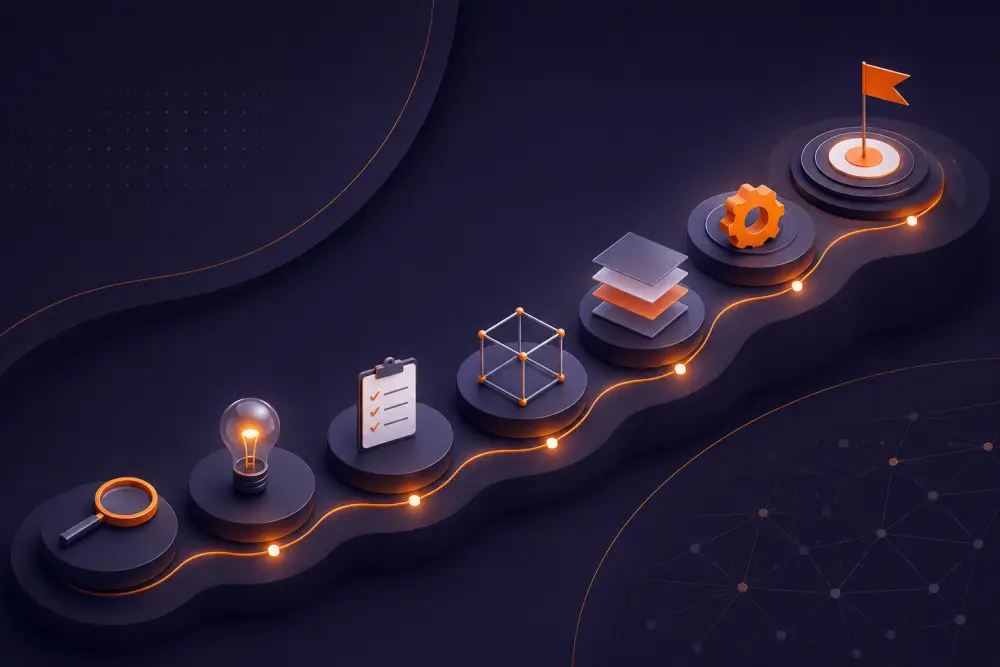
The 7 stages of the product development process are best understood as checkpoints. Each one reduces risk before moving forward.
1. Idea Generation And Problem Definition
Every product starts with a product idea. But what matters is whether that idea solves a real problem.
This stage focuses on understanding customer needs through market research and user research. It’s where teams define the problem clearly and begin shaping a product vision.
When this step is rushed, teams often build features instead of solutions.
2. Idea Screening And Prioritization
Not every idea deserves to move forward.
This stage filters ideas based on value, feasibility, and alignment with product strategy. It’s where teams begin to prioritize under real constraints.
Disciplined prioritization is what separates successful product development from wasted investment. Strong teams avoid overcommitting and focus on what truly matters.
3. Concept Development And Validation
At this stage, the product concept becomes tangible.
Teams create prototypes or early versions of the product and begin gathering user feedback. This is where assumptions are tested in the real world.
Validation is critical. Without it, teams risk building a product that looks right internally but doesn’t meet actual user needs.
Research from CB Insights consistently shows that building products with no market need is one of the top reasons startups fail.
4. Business And Technical Feasibility
This is where ideas meet engineering reality.
Teams evaluate whether the product can be built, scaled, and maintained effectively. This includes decisions around architecture, infrastructure, and system design.
For example, choosing between a monolith and microservices architecture is not just a technical decision it directly affects scalability and operational complexity.
AWS provides a practical breakdown of these trade-offs in modern systems design.
This stage often determines whether a product will hold up under growth.
5. Product Design And Development
Now the product development team begins building.
This stage includes backend systems, frontend interfaces, APIs, and integrations. It’s where product design and engineering come together.
Teams typically work in iterations, often using agile methodologies. Adaptability and continuous delivery is key to effective product development.
Clear communication between product management and engineering is essential. Without it, priorities drift and delivery slows.
6. Testing, QA, And Performance Validation
Testing is not something that happens at the end. It should be part of the development process from the start.
This stage ensures the product meets quality standards and performs reliably under real conditions.
Google’s engineering practices emphasize that early and continuous testing improves system reliability and reduces production risk.
Products that skip this discipline often face issues after launch when fixes are more complex and costly.
7. Launch And Iteration
The product launch is not the finish line. It’s the beginning of real-world feedback.
Once the product is live, teams monitor performance, gather user feedback, and continue to refine the product.
This creates a feedback loop that drives continuous improvement—one of the defining traits of successful product development.
Where Teams Lose Time And Increase Risk
Even with a defined product development lifecycle, problems tend to appear in familiar places.
Skipping validation is one of the most common. Teams move from idea to development too quickly, assuming they understand the user.
Misalignment between product management and engineering is another. When priorities are unclear, delivery slows and quality drops.
Technical decisions are also underestimated. Early choices around backend systems, APIs, and infrastructure can either support growth or limit it.
Finally, QA is often treated as a final step rather than an ongoing process. This creates instability that only becomes visible after launch.
Reduce risk before you build
Take a step back before development starts. A few focused decisions early can prevent costly rework and set your product up to scale with confidence.
How To Build A Product Development Process That Scales
A scalable product development process doesn’t need to be complex. It needs to be clear.
It starts with alignment. Product strategy should directly inform what gets built and why.
Team structure matters too. Effective development teams operate with clear ownership and short iteration cycles, improving both speed and accountability.
Feedback loops reduce risk across the lifecycle. Teams that consistently gather feedback—during validation, development, and after launch make better decisions over time.
At the same time, speed needs to be balanced with reliability. Shipping quickly is valuable, but only if the system can support growth.
Modern Product Development Requires More Than Code
Today’s product development lifecycle goes beyond building features.
Cloud infrastructure and DevOps practices now play a central role. They enable faster deployments, better scalability, and more reliable systems.
The Google Cloud Architecture Framework outlines how modern systems are designed for reliability, scalability, and operational efficiency.
AI and automation are also becoming part of many products. But they need to be implemented with clear use cases not added for the sake of trend adoption.
Across all of this, technical debt is unavoidable. The goal is to manage it intentionally and avoid decisions that block future growth.
When To Build In-House Vs Partner With A Development Team
This decision often comes down to capacity, expertise, and long-term goals.
Consider external support when:
- Your team is stretched across priorities
- You lack specific technical expertise
- Delivery timelines are slipping
The right product development partner brings experience across the full lifecycle from product strategy to system design and scaling.
How To Move From Idea To Scalable Product
Building Something That Needs To Scale?
Most teams don’t need more ideas. They need a clearer way to move through the product development lifecycle without creating problems that surface later.
If you’re working through decisions around MVP development, backend architecture, cloud infrastructure, or scaling an existing product, those choices are easier to get right early than to fix later.
If it helps to talk things through, you can explore how Lerpal approaches product development and engineering, or simply contact us to discuss what you’re building.
A short conversation can often bring clarity to the next step.
Frequently Asked Questions
Why is the product development life cycle important?
The product development lifecycle provides structure to what can otherwise become a reactive process.
It helps teams validate ideas early, align product strategy with engineering, and avoid costly rework. Without it, teams often move fast but in the wrong direction.
Which stage of product development is most critical?
How long does the product development process take?
What is the difference between MVP and full product development?
An MVP (minimum viable product) focuses on validating a core idea with minimal features.
Full product development expands that into a scalable, production-ready system with robust architecture, performance, and user experience.
Both follow the same product development process but with different depth and scope
When should you invest in scalability and infrastructure?
Should you build in-house or work with a product development partner?

You may also like



Talk With Our Experts



Get advice and find the best solution