
How to Use AI in System Design Without Overengineering
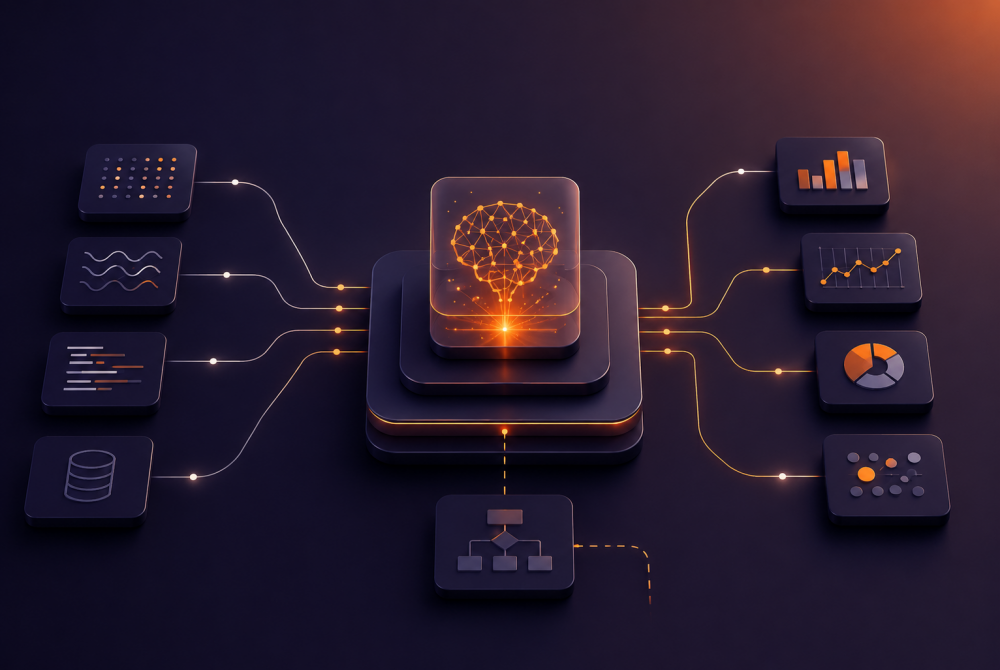
Many teams don’t struggle with AI capability but with where and how to use it.
The models work, APIs are accessible, tooling has matured enough that integrating an LLM into a workflow takes hours, not months. And yet, McKinsey’s 2025 State of AI found that only 23% of enterprises are scaling AI systems into production. Another 39% remain stuck in experimentation. The gap between “we built a demo” and “this runs reliably every day” keeps growing.
The most common reason? Overengineering.
Overengineering happens when AI gets added without clear system intent.
A classification task becomes a multi-agent pipeline.
A simple retrieval workflow becomes an agentic architecture with six LLM calls per query.
The system gets more complex, harder to debug and no better at the thing it was supposed to do.
Good AI system design is intentional, constrained and well-structured. Whether you’re preparing for a system design interview or building production infrastructure, the principles are the same.
Our article is how to get there.
Start with System Design, Not AI
Before introducing any artificial intelligence component, define what the system is supposed to do at a high-level. It gets skipped constantly.
Define system goals, inputs and outputs
- What goes in?
- What comes out?
- What does the system need to achieve?
These questions have clear answers for most workflows, and those answers should be written down before anyone even mentions a model. If you can’t describe the system’s purpose in one sentence, then the architecture will reflect that confusion.
Identify decision points in the workflow
Walk through the workflow step by step.
- Where does a decision happen?
- Where does uncertainty exist?
- Where does a human currently make a judgment call?
These are your candidate locations for AI. Everything else should stay deterministic.
Separate deterministic logic from uncertain tasks
If a decision is predictable and rule-based, AI is likely unnecessary. A status check, a threshold comparison, a routing decision based on known criteria – all these belong in traditional logic.
AI belongs where the input is ambiguous, the patterns are complex or the volume makes human review impractical.
Where AI Adds Value in a System
AI is most useful where uncertainty exists. Designing systems around this principle prevents the most common overengineering mistakes.
Pattern recognition and classification
Categorizing documents, detecting anomalies in transactions, routing support tickets by intent – tasks where AI models excel because the inputs are variable and the patterns are learnable. A well-trained classifier running on a simple pipeline delivers more real-world value than most elaborate architectures.
Generative tasks
Text generation, summarisation, extraction, content drafting – the generative use cases where LLMs shine. These work well when the output has a clear validation path.
Retrieval-based systems (RAG workflows)
When the system needs to answer questions grounded in specific data like internal documentation, product catalogues, knowledge bases, retrieval-augmented generation is the pattern.
A query hits a vector database, retrieves relevant context and an LLM generates an answer grounded in that context. RAG stays simple when you keep the retrieval pipeline clean and the prompt structured.
AI-powered interfaces vs. backend logic
Sometimes AI belongs at the interface layer: a natural language query parser, a conversational UI, a search experience. Sometimes it belongs in the backend: classification, scoring, extraction.
Where the AI component sits in your architecture affects latency, cost, scalability and debuggability.
Where AI Does Not Belong
Misplacing AI is the fastest path to overengineering.
Deterministic workflows
If the logic can be expressed as a decision tree, a set of rules or a lookup table, an LLM adds cost and unpredictability without adding value that you need in the first place. Don’t use AI to do what a conditional statement does perfectly well.
Critical system paths without fallback
AI outputs are probabilistic. Putting an LLM on a critical path with no fallback is asking for production incidents. Every AI component in a system needs a graceful degradation path.
High-risk decisions without validation
Financial approvals, medical recommendations, legal determinations require human oversight. AI can assist and surface information, but the final decision should pass through a validation layer.
Common misuse patterns to avoid:
- Using generative AI where a database query would suffice;
- Running multi-agent orchestration for a single-step task;
- Treating LLM output as deterministic;
- Adding AI just because stakeholders asked for “something with AI”.
Designing Simple AI System Architecture
Keep architecture understandable before making it advanced.
Basic AI pipeline:
Input → preprocessing → model call → output validation → action.
This pipeline handles most AI use cases. Start here and add complexity only when this pattern demonstrably can’t solve the problem.
When to introduce retrieval (RAG)
Add retrieval when the AI component needs context that isn’t in the model’s training data:
- company-specific documents;
- recent data;
- domain knowledge.
The architecture extends to:
input → query embedding → vector search → context assembly → model call → output.
Datadog’s 2026 State of AI Engineering report found that agentic framework adoption nearly doubled year over year, rising from 9% to 18% of organisations, but the majority of production AI systems still run on simpler patterns.
Using cache to reduce cost and latency
If the same queries hit your AI pipeline repeatedly, cache the responses. Semantic caching (matching similar queries to cached results) reduces API costs and improves responsiveness without adding architectural complexity. One of the highest-ROI optimisations in AI system design and one of the most overlooked.
Avoiding premature multi-agent systems
Multi-agent architectures are powerful for complex, multi-step reasoning tasks. They’re also expensive, hard to debug and overkill for 90% of current production use cases.
Deloitte’s 2026 State of AI report found that only one in five companies has a mature governance model for agentic AI — even as adoption accelerates. Start with single-purpose AI components. Graduate to agents when the use case genuinely demands autonomous multi-step reasoning.
| Feature | Simple Pipeline | Agentic Architecture |
|---|---|---|
| Best for | Classification, extraction, single-step generation | Multi-step reasoning, dynamic tool use |
| Complexity | Low | High |
| Debuggability | Straightforward | Requires dedicated observability |
| Cost | Predictable | Variable (scales with steps) |
| When to use | Most production use cases today | Complex workflows with genuine autonomy needs |
Prompt Design as a System Interface
Prompts shape system behaviour. In production AI systems, they deserve the same discipline as any other system interface.
Structuring prompts for consistency
Use clear instructions, define the expected output format and include examples where they reduce variability. A well-structured prompt acts like a contract: specify the role, the task, the constraints and the expected response schema. Teams that treat prompts as throwaway strings end up debugging output randomness instead of building features.
Handling variability in outputs
LLM outputs are inherently variable. Even with identical prompts, responses can differ in structure, length and content. Handle this with validation layers downstream: parse outputs against expected schemas, reject malformed responses and retry or fall back when the output doesn’t match.
Prompt versioning and iteration
Treat prompt versioning like code versioning: track changes, test regressions before deploying and roll back when quality degrades. Tag each version, log which version produced which outputs and tie changes to measurable quality metrics.
Add Guardrails, Not Complexity
AI systems need constraints rather than more intelligence.
- Output validation and filtering.
Every AI output should pass through a validation layer before reaching the user or the next system. Schema validation, content filtering, format checking are cheap to implement and prevent the most embarrassing failures.
- Confidence thresholds.
When the model’s confidence is low, route to a fallback: a human reviewer, a simpler algorithm, a “I don’t know” response. Confident wrong answers are worse than honest uncertainty.
- Fallback mechanisms.
Every AI-powered path needs a non-AI alternative. When the API is down, when the model hallucinates, when latency spikes, then the system should degrade gracefully rather than fail. Completely.
Minimum guardrails for production systems:
- Input sanitisation (prevent prompt injection);
- Output schema validation;
- Confidence-based routing;
- Rate limiting and cost controls;
- Logging for every model call (input, output, latency, token count).
Design for the problem, not the model
Start with the system constraints that matter most, then use AI where it removes complexity or improves outcomes. Simpler architectures are usually easier to scale, maintain, and trust.
Designing Workflows Around AI
AI should fit into workflows, not replace them entirely.
Human-in-the-loop decision points
For high-stakes or ambiguous decisions, design explicit review steps where a human validates the AI’s recommendation before the system proceeds. Content moderation, financial scoring, medical triage, anywhere the cost of a wrong decision outweighs the cost of a short delay.
Automation vs. augmentation
Classification of low-risk support tickets? Automate.
Drafting a legal summary for client review? Augment.
The distinction determines how much control and oversight the workflow needs. Default to augmentation when the stakes are high or the domain is complex.
Workflow orchestration basics
When AI is one step in a larger process, keep orchestration simple: a task queue, clear handoffs between steps and well-defined input-output contracts for each stage. Avoid building custom orchestration engines when existing frameworks handle the pattern.
Managing Tradeoffs in AI System Design
Every AI system involves tradeoffs. Making them explicit prevents surprises in production.
| Lower End | Higher End | How to Evaluate | |
|---|---|---|---|
| Accuracy vs. latency | Faster responses, more errors | Slower, more precise | Match to user expectations and use case criticality |
| Cost vs. scalability | Cheaper per call, limited scale | Higher cost, elastic scaling | Model against realistic traffic projections |
| Flexibility vs. reliability | Adaptable, less predictable | Constrained, more stable | Prioritise reliability for production; flexibility for experimentation |
Scaling AI Systems Without Overengineering
Start small, then expand deliberately.
- Single-purpose AI components first.
One model, one task, one clear input-output contract. Compose these into larger systems when the individual components are stable and well-understood.
- Observability and logging.
Log every AI interaction: inputs, outputs, latency, cost, error rates. Without observability you can’t optimize, debug or explain what the system did or why.
- Iterative improvement loops.
Collect feedback on AI outputs. Use it to refine prompts, adjust confidence thresholds and improve over time. The best AI systems improve continuously because they’re designed to learn from production behaviour.
A Practical High-Level Architecture You Can Use
Most AI-enabled systems fit a five-layer reference model. Before reaching for a framework, map your system to these layers.
Input layer
Where data enters: user queries, uploaded documents, API calls, webhook events. This layer handles parsing, normalisation and initial validation. Malformed or adversarial inputs get caught here, before they reach anything expensive.
Processing layer
Deterministic logic lives here: routing, enrichment, transformation, business rules. If a request can be resolved without AI — a database lookup, a rules-based decision, a cached response — it gets handled at this layer and never touches the model.
AI component
The model calls itself. Keep it thin: one model, one task, one clear prompt. Pass in only the context the model needs. If you’re using RAG, the retrieval step feeds context into this layer.
Validation layer
Every AI output passes through validation before moving downstream. Schema checks, confidence thresholds, content filtering. This layer turns probabilistic outputs into something the rest of the system can trust. If validation fails, route to a fallback — not to a crash.
Decision and action layer
The validated output triggers an action: a response to the user, a database write, a notification, a handoff to a human reviewer. This layer owns final decision logic and human-in-the-loop checkpoints for high-stakes workflows.
The flow: Input → processing → AI component → validation → decision/Action. Each layer has a single responsibility, a clear interface and a fallback path.
Common Mistakes That Lead to Overengineering
Most complexity comes from avoidable design decisions:
- Starting with tools (LangChain, vector databases, GPU clusters) instead of problems;
- Overusing agentic or multi-agent setups for tasks that don’t require autonomy;
- Skipping validation layers because “the model is good enough”;
- Treating AI output as deterministic when it is fundamentally probabilistic;
- Fine-tuning when prompt engineering would suffice;
- Writing custom coding for AI orchestration when existing frameworks handle the pattern.
Design for Reliability, Not Novelty
AI systems don’t need to be complex to be powerful. They need to be well-placed, well-bounded and easy to reason about.
The teams shipping real-world AI systems at scale tend to share a pattern: simple architectures, strong guardrails, clear ownership of each AI component and a willingness to use traditional logic where it works better. The novelty is in what the system achieves, not in how many layers the architecture has.
At Lerpal, we help organisations design and build AI systems that work in production: scalable, observable, maintainable. We’ve spent years integrating AI into real systems across media, fintech and enterprise software, and the approach is always the same: start with the problem, design the architecture, add AI where it genuinely helps and keep everything as simple as the requirements allow.
Let’s design an AI system that works without the unnecessary complexity.

You may also like



Talk With Our Experts



Get advice and find the best solution